Taste Bud

When I think of those years,

The spicy and the dicey years

of my long-since past misspent lost youth,

I no longer have regrets.

I’m now seasoned, steady, sublime

I embrace it all as a part of my truth.

Inspired by The Daily Post Daily Word Prompt: spicy

Fun fact: Did you know that someone just recently decided to make “hot and spicy condoms?” Yep. Hmmm. Really?

Mull on that one a while…


Lust Life

Much of my adult life has been about coming to terms with lust.

Having grown up in a fairly conservative family with mainly Protestant roots, I learned early on to deny and repress my lust: for life, for sex, for fame, for love, for food.

So much so that I lived a kind of double life from my teens into my twenties.

I hid many behaviors that all revolved around my various appetites. Somewhere in my somewhat stunted emotional development, I had learned that being seen as having a need (be it physical or otherwise) was weak, unattractive.

And so I learned to pretend I did not have them.

And yet, at the same time, I also had a very strong need to be seen as a sexual object. (See Sexual Healing, my previous post on this issue.) This presented quite a war within me. I desperately wanted to be seen and treated like a sexually desirable woman – that was sort of the ultimate need. At the same time, I had shame and embarrassment around this and had strong messaging that that was bad, and that I should be a good girl with no sexuality, appetites, strong opinions or feelings.

And so I pretended to be one one way while in secret I acted in other ways.

I invested a great deal of time into creating the illusion that I was chaste, a normal eater, and had  a very neutral opinion on just about everything. I monitored my emotions and watched myself around people, carefully choosing mannerisms and tones to project a good girl.

Meanwhile, I was living quite another kind of life, a life I hid from my family, my friends. A life of appetite and lust and danger.

There were certainly angels watching over me. I was often in the wrong places at the wrong time. Somehow, I survived.

At a certain point in my twenties, the jig was up, as they say.

My psyche demanded that I heal the split, and I began the process of recovering wholeness again.

Of uncovering my own genuine appetites from a place of love, curiosity and acceptance. Of letting go of the urge to keep my appetites hidden.

I began a process of embracing of my true nature and wants and needs as beautiful reflections of my own humanity. I began the shedding of the shaming nature that I inherited.

An unlearning of the social pressure that happens in middle school to put a damper on enthusiasm, to keep a lid on want to look cool.

I learned to let myself eat as I really wanted to in front of others.

I learned to let myself be seen trying, excited, wanting, sexy, hungry, angry, hopeful, happy, disappointed, frightened, messy, unhappy, empty, full, vulnerable, awkward, lonely, blissful.

I learned to let myself be seen. As I really am.

Today I value the self-honesty that I live from. Truth is of huge importance to me.

Though I am still in awe of the capacity I had within my own psyche to maintain such a dichotomy the way I did – that I could compartmentalize two such distinct worlds at once – I am so grateful that that is just a chapter in my story.

Today, I have one world with many parts: parts that co-mingle and bring me great joy in their diversity.

I celebrate my appetites, I revel in my enthusiasms and passions.

I love my lust. It is what lets me know I am human. And alive.

So today, I try to wear my lust like a smile.


Inspired by The Daily Post Daily Word Prompt: lust


True Grit

My Dad and I had a very complicated relationship.

There were years we barely spoke, by my choice.

Our relationship was damaged in my early childhood, and afterwards, it was always in one phase or another of dysfunction.

I reached a point in my adulthood where I decided that it was best for my health to remove myself from the dynamic. And I thought that would pretty much be it for the remainder of my life, and I was OK with that decision.

Until, that is, my mother’s cancer.

Life is funny that way. You can think that a part of your life is beyond repair, and then lo and behold, Life brings you the only exact set of circumstances under which you would ever come together again.

In 2005, my mother was diagnosed with lung cancer. She underwent radiation therapy (two rounds) and then chemotherapies (2.) I traveled down to Texas to visit often to be with her, me tersely tolerating my father, and he giving me a wide berth out of hurt respect of my former choice. (I also always took my then-boyfriend with me as buffer.)

Then in 2006, after the family gathering at Christmas, which was more uncomfortable than usual, my parents called to tell me that they had been informed by my mother’s oncologist that no more could be done for her. (I will never forget the agony of that call.)

Just like that, all bets were off.

It had been decided that she would be having home hospice care to make her as comfortable as possible. As happens in such situations, we were still hopeful that she could live for some time. No one can predict how things will really go, you tell yourself.

I started going to Houston weekly to be with her. My father and I, out of necessity and shared concern, began to interact more and more, all having to do with her and her health needs.

We found our way to something new, something beyond the pain of the past, for her sake. And later, after the inevitable happened, for ours.

In the weeks following my mother’s death, my father was diagnosed with acute myeloid leukemia. Now, my father had been a strapping, big and tall and healthy man his entire life. Never much more than allergies. But I think the stress of losing his beloved sweetheart of 54 years created the perfect storm in his system, and the cancer that might have lain dormant for years just took over the weakened man.

In the midst of undergoing tremendous grief (he’d also lost his father the year before,) my father had to make decisions regarding his own illness, which was acute and generally swift-moving. The standard treatment available was quite harsh. He decided to go an alternative route in order to potentially benefit others by entering into an clinical trial at MD Anderson Hospital to receive experimental drugs instead of the standard approach, which was tough to survive in and of itself.

So I continued my visits. My remaining brother lived in Houston, so he became the primary caregiver, which I was grateful for. But I went down as often as possible and our new relationship began to grow into a new chapter, slowly, carefully.

And in the year following, when one of my two brothers also died, unexpectedly, again, all bets were off.

I watched this man who was so complicated for me, who had hurt me in such far-reaching ways, suffer the loss of his lifelong love and his son. These losses broke him apart. He went through pain that I would not have wished on my worst enemy.

(And he was my worst enemy.)

Somewhere there in the midst of it all, after a lifetime of seeing no way to ever being able to forgive this man, I suddenly was able to see that he was worthy of my forgiveness. That I had been given forgiveness in my life, and that he, too, should be given that as well. That he was not beyond forgiveness, in some separate category unlike anyone else on the planet.

I guess I was finally able to see him just as a flawed man, finally, and not as the monster I had experienced and protected my heart from for all those years. (Perhaps justifiably, one might argue. But things had changed. And those changes had allowed for a shift of my perception. And that shift allowed yet a new phase of our new relationship.)

In the remaining time of his life, we found our way to a loving father-daughter relationship.

How did this miracle happen?

I think for me, part of it was seeing the sacrifice and the bravery with which he committed himself to surviving his cancer for those of us who remained and loved him.

I know that in his heart he was grief-stricken and lost without my mother and would have loved nothing better than to close his eyes and just let go, to die and be with her. But he fought on, for us.

And after my brother died, that grief was multiplied by 30, and yet still he fought on, for my remaining brother and I. My then-boyfriend-turned-fiance after my mother died, and in the midst of it all we were planning a wedding: a wedding my mother and my father had always wanted for me. He was fighting to walk me down the aisle. And to carry her memory on for his two young grandchildren.

He withstood grueling chemo treatments and daily hospital trips where he sat for hours going through the process required of his treatment. Hours spent sitting and waiting and getting tests and giving blood and getting chemo. Medications at home. The affect the treatment had on his body and spirit. His diminishing physical strength.

This big and tall, towering Texas man became a thin wisp of his former self, eventually walking with a cane.

And through it all, he never once complained.

Three months before my wedding date, he got a virus caught during one of the daily hospital visits. I went home on my usual trip but this time visited him in the hospital, where he had to be in a protected environment.

There, I could see that he was truly exhausted. Spiritually. Emotionally.

That the true grit that had been getting him through, that amazing reserve within that he had been tapping into for so long for our sake, was nearing empty. He had been fighting to give me these last acts of fatherhood, this time of repair, this time of untainted love. I knew this and I was so very grateful for it all. I knew that this time had been a supreme gift that would change the quality of my remaining time on the planet for the better. That my whole relationship to life had shifted for the better.

And so I gave him the last gift I could give him as a daughter. I gave him my permission to let go of the fight.

There are times when life provides you with an open door, and if you are paying attention, you see it and you walk through, somehow knowing that it is what you should do.

When a moment arose in the conversation that invited such a thing to say, I took it.

I told him we loved him and were thankful for everything he had been doing. For how hard he had been fighting for us, to be there for the wedding and for the kids. But that I would never want him to stay on if he truly no longer wanted to. That he had done it all, he had fathered through like a warrior, but that if, at any point, he was ready, that we would want him to let go. That we would be OK. That I would be OK. That he and I were OK.

It was just a few sentences. He knew and I knew what we were saying to each other. He said he wasn’t at that point quite yet but he could understand a time of coming to that point.

When it was time to leave, I told him I loved him, and meant it. I thanked him for being my father, and I meant that too. And I thanked him for fighting so hard to be there for me.

He passed away the next week, after returning home, having come through the virus. My brother found him laying alongside the bed, as if he’d gotten up in the night and collapsed.

I hope he felt at peace when the moment came. Perhaps he was walking towards the sound of my mother’s voice. I like to think so.

My love for him is complicted, yes. But it is true. As true as the grit that he was made of.

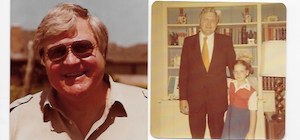
2009-07-24-15-22-58-e1499812592237.jpg Dad and I at the civil ceremony of my marriage, 8 mo before he died.

Inspired by The Daily Post Daily Word Prompt: grit


Constant Craving

When I was a girl, I lived for food.

The promise of the after-school snack kept me going through the grueling days of my youth. I’d race home to find sweet and savory relief from the confusion of adolescence.

I’d eat from a box of graham crackers, spreading layers of vanillla chocolate chip canned frosting. Or I’d slice up a Snickers bar the way they did in a commercial on at the time, pretending I was in it. Then maybe some Lay’s potato chips. Maybe a Wonder Bread/Gulden’s Mustard/Kraft cheese and baloney sandwich.

I was on my own, so I could eat like I wanted to. No father home yet to bring tension and self-consciousness to the air.

I’d fill myself, quelling the uncomfortable thoughts and feelings that haunted me at any other time of my day. This was all mine. My time free from criticism, pressure or fear.

Over the years, I became desperate around this intimate connection with food. Protective of the rituals. The private pleasure I found in food and the act of eating it.

I knew something was off about how I related to food. I felt ashamed and like there was something wrong with me, while at the same time feeling like it was crucial to my very existence. That trichotomy created a painful struggle inside me of shame and appetite and need.

I became secretive around it, knowing on some level that I was not like other people.

I now understand that somewhere along the way, I learned to equate food with so many things I needed: love, attention, security, connectedness, relief, quiet, peace, pleasure, a sense of having something for myself, a way to feel like I had control of one thing in the world.

I believe that some of this relationship to food was learned, familial. My mother, too, sought refuge in her treats. She loved candy, and when I came home from school, she was usually lying in her bed, reading mystery novels, eating candy from a stash she kept in her bedside table. She, too, at some point in her life, reached for food to solve and resolve being on this planet.

I understood her for this. I feel such compassion for her. For her huge needs and the dysfunctional way she had developed to cope with getting them met.

It has taken many years of unraveling this connection for me to find a new relationship to food. There’s been tremendous loss in it. A loss of my friend, my savior, my companion, my sidekick.

But it has been so freeing, too. I have  been learning how to give myself what I had asked for from food all those years: love.

Sounds easy, and obvious, right? But what does that actually look like?

It looks like this: giving myself The Five A’s of Love: Attention, Acceptance, Appreciation, Affection, and Allowing.

(The Five A’s concept is from the wonderful book How To Be An Adult in Relationships – Five Keys to Mindful Loving by psychotherapist, David Richo, PhD.)

Those Five A’s satisfy the snack craving every time. I’m not saying I don’t still crave and even miss that snack eating ritual. I do. That’s a deeply embedded habit. I got pretty hard-wired around it.

But today, I take the snack-seeking girl inside by the hand, and I ask her what she really needs. 

Sometimes it is some appreciation for all I have been doing all day.

Sometimes it is affection. Maybe a bath. Some demonstration of loving care.

Maybe it is the need to be allowed to really acknowledge feeling afraid, or spent, or angry.

It took awhile for that part of myself to trust that my needs could be met in new ways. To trust in something other than food.

To trust life. To trust love. To trust loving myself, in life.

It is an every day practice, this mindfulness of love. I pour the energy I used to hold for food into other things. Sometimes I wish I hadn’t gotten my wires crossed, that food wasn’t so complicated for me.
But it is.

And so I accept this truth as if I were diabetic, and I do what I need to do to care for myself.

Mostly, as I said, I feel free.

I no longer carry that shame I felt around it. I am literally lighter in spirit. That feeling is the prize I keep my sights on. It is what makes it all worth it.

I may no longer “have” snacks. But I have me.

Inspired by The Daily Post Daily Word Prompt: snack

Athlete, Interrupted

Growing up, I was that kid who hated gym.

I’d try to hide when it was side-picking time. I’d try to avoid someone passing the ball during basketball. I’d get in the far outfield in softball. Volleyball? It was simply terrifying. There was nowhere to hide.

I could barely run a lap. I couldn’t do one pull up or push up.

I had zero confidence in my self. I was awkward physically, and had no sense of athleticism.

I decided early on that I did not have the right body for sports like running. I was too shapely and too heavy.

I tried. Boy did I try. Despite my social shyness, my physical awkwardness, my lack of self-assurance, I scraped together what pluck I could and tried to be on teams anyway.

They were a series of humbling failures.

As a very young girl, I had loved to move. I took ballet, tap and jazz from ages 3 -6, and I loved it. I danced all around my room at home, choreographing dances to well-worn albums of my parents’.

But after a move and a series of significant events in my sixth year, I became disconnected to my body. I began to live in my head, in a fantasy world created to blot out a reality that I was not equipped to handle.

And I turned to food as my, well, my everything. It numbed me out, it made me feel good, it comforted me, filled me, calmed me, excited me, made me feel safe, made me feel a part of something. It was my weapon, my barrier, my mode of expression. It was a mood stabilizer and alterer. My best friend, my lover, my family. My church.

So no wonder I became uncomfortable in my own skin and body and had trouble being in the world within it.

Mix in the social world of sports, and it was a recipe for disaster.

Later, after I lost weight rapidly on an extreme diet one summer when I was 12, I started exercising compulsively. I didn’t realize it at the time. I justified it. It was healthy, after all, to work out, right?

I lost and maintained a new, better looking weight, but I was just as disconnected from my body. As a matter of fact, though I knew I looked better to the world at this lower weight (suddenly I got positive attention – people wanted to know me,) I did not love myself any more than before. I actually became even more critical of my body. You could even say I hated it on some level.

It was never good enough. I wanted my body to look like the models in the glossy magazines I grew up reading. To be like the women in the movies and on TV. Like the girls at school that were popular and voted Most Beautiful. I compared the way I looked to world I was surrounded by in the media, and I always fell way short.

I concluded that in order to be lovable, I needed to look like them. Since I didn’t, I was doomed to a lonely, loveless, “loser” life. In my emotionally immature logic, I decided I had two choices: kill myself or reinvent myself.

So I turned to exercise as I had to food. It was a great way to numb out. A great thing to become obsessively-compulsive about. It’s much easier to disguise a disordered relationship with your body by working out too much. Most people think you are “just fine.” Our culture supports the idea of killing it at the gym: “No pain, no gain.” “Transform your body, transform your life.”

At my worst, I was working out 3 hours daily. My body ached, but I seldom noticed. My periods stopped and I felt exhausted all the time. My hair and skin looked awful.

There came a time when I realized that I wasn’t comfortable being around other people unless I had worked out for three hours. I started to understand that something was still way out of whack between me and my body.

Eventually, my world came to a crashing halt. My body simply could not withstand the way I was treating it.

I now understand how amazing the human body is. That it innately seeks healing and balance and has an intelligence far superior than that of my mind. My body called a halt to the imbalanced, disordered behavior, and demanded that I examine and re-approach my relationship to it.

Fast forward many years of therapy and recovery. I eventually have come to a place of understanding and connection again with my own body. A place of loving it as it is, even. (That journey is many blogs’ worth. Today I wanted to share about some of the fruits of that journey so far.)

After much healing, I started to work out again, but with the sole intention of doing it for my health, and for the pure pleasure of moving my body. I learned to listen to my body, giving it rest and recovery when needed. I found that early girl’s love of moving and I gave her plenty of space to play.

And at a certain point, after all those years of telling myself that it just wasn’t in the cards for me, I started to run.

In 2012, just after I had set a New Years’ intention of finding my inner athlete, I heard of an app that helped you go from “couch potato” to 5k runner. I was very inspired hearing about how well it had worked for a friend of mine. In June of that year, I started using it, and within a month, I was running 5k distances with ease.

And I found that I loved running! I started running 5 days a week, and it quickly became a major area of focus in my life. I ran a 5k race towards the end of 2012 on a lark, and discovered how much I loved running with a herd of other runners.

From that 5k, I ran a 10 miler, followed by a half marathon in Jan. 2013. I ran more half marathons in 2013, loving the training process. Training and racing became an important part of my life. I trained no matter what, and really began to feel like I had finally found my inner athlete.

And then, in 2014,  I ran my first marathon: the NYC Marathon. Crossing that finish line was a personal triumph for me for so many reasons. Not only was it an amazing accomplishment to have trained for such an iconic race and to finish it.

But to have brought myself through full circle from a child at home in her body, loving using it, to being completely shut down to my own physical life, to brutalizing it with disregard in order to become someone more lovable, to acceptance for and love of, to testing, training and ultimately celebrating the abilities of my own body.

I wept, as so many do, as I crossed that finish line. For the girl I had been before being interrupted. For the girl who got so lost and misdirected. I cried out of grief for all that they had lost. And I wept with joy for all I had come through, and for where I had brought myself to.

Today, I still love running. But I have continued to listen to my body, and today, she wants some different kinds of movement. I still run, but am not training and racing. I love those years where it held such prominence in my life. It was a five year span of joy, and I  learned so many things about how strong I am, and what amazing discipline I am capable of. But I’m seeking other experiences now.

I’ve been taking tap, which has been amazing to rediscover. (My inner 4 year-old is very happy!) I’d like to start taking ballroom dancing too. I am listening to see what is next. I trust my body will lead me where I most need to go. I know I will be moving, somehow.

My inner athlete is ever alive. Now that I found her, I will never let her go.

#itsnevertoolate #runforlife #running #runner #innerathlete

Inspired by The Daily Post Daily Word Prompt: triumph


Breaking Through

There’s new growth inside

Tiny greens are poking through

In-between the cracks of my heart

Tender tendrils of hope

Pushing promises of freedom

Of joy and release

And of peace at last

I attend to their needs with full study

I patiently await what will bud